


By Patrick Opio
Senior Communications Officer
Lira University Council Chairperson, Mr. David Geoffrey Opiokello has encouraged Faculty and Department Heads of the University to plan for community engagement activities in the 2027/2028 Financial Year budget.
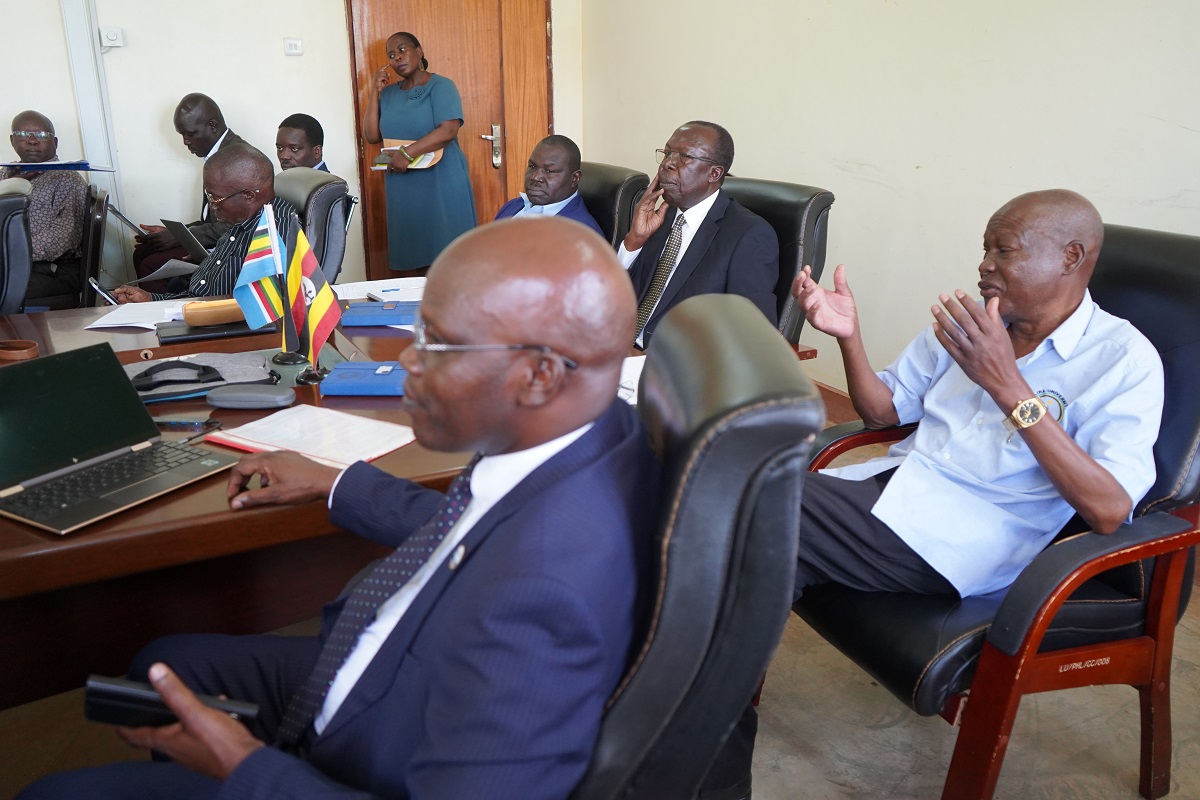
Mr. Opiokello noted that the University community driven programmes bridge academic training with local societal needs. He was addressing Council Members and Technical staff at the 2027/2028 FY Budget Conference held at the Public Health Board Room on 15th October 2026.
Mr. Opiokello, retired Deputy Governor, Bank of Uganda, said, the Government, with its various development programmes, hopes to achieve ambitious target in the economic growth and consequent transformation in the society, but the major question of impact of the Public Agencies including universities’ deliverables on the citizens must be clear in the minds of the drivers of these agencies.
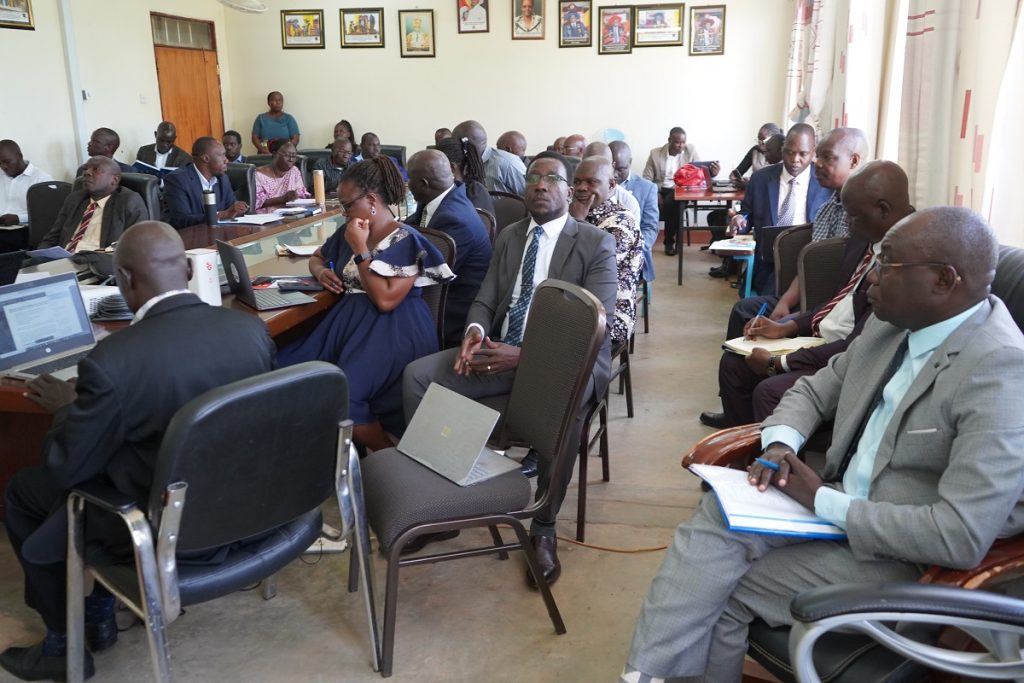
Council members and technical staff at the Budget Conference
“As you make a budget, think about the community outreaches or engagements. Which activity in your faculty or department will directly benefit the community. Remember the presence of the university in the area or region must be felt and appreciated by the local community,” he said.
Mr. Opiokelllo said the excellent and effective governance will improve the university performance by strengthening accountability, boosting financial results, and enhancing public service delivery.
Vice Chancellor, Prof. Jasper Ogwal Okeng advised staff to priorities the resources that keep the University operational. “We must ensure that the resulting budget proposals are evidence-based, properly prioritised and aligned with the University’s strategic objectives. In particular, student activities must be clearly articulated and adequately provided for, recognizing that students are at the heart of our institutional mandate”, Prof. Ogwal Okeng advised.
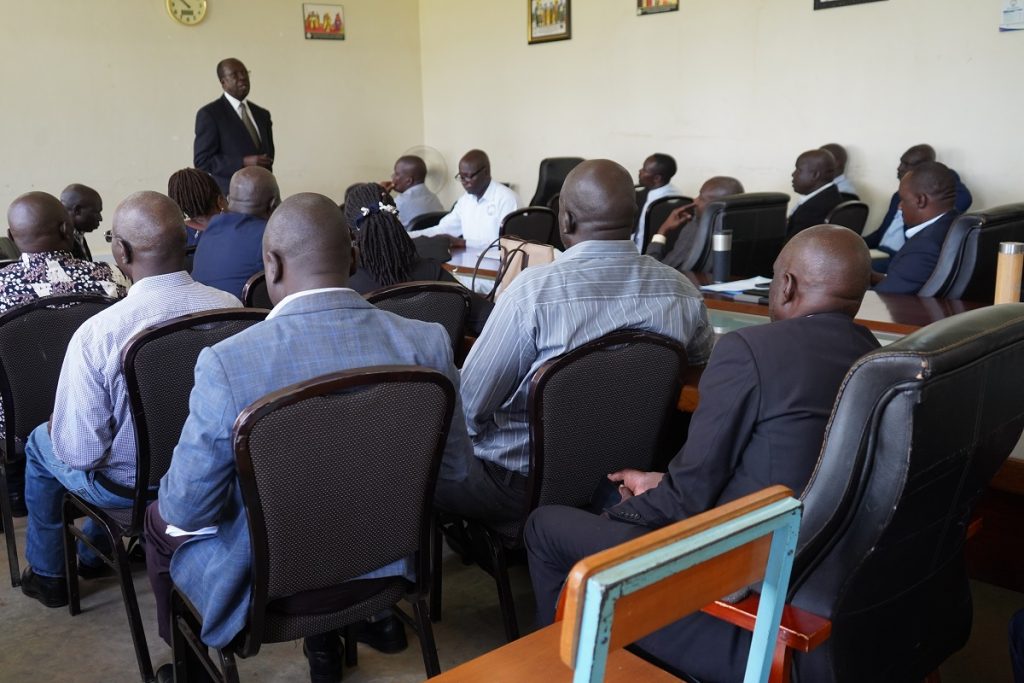
Mr. Geoffrey David Opiokello addressing the Budget Conference held at Public Health Board Room
The VC revealed that research, innovation and partnerships must receive strategic attention. “Our budget should therefore support research development, collaborative initiatives, academic exchange, international partnerships and staff and student mobility.
Prof. Ogwal Okeng emphasized mutual trust and respect in the faculties and departments for the planned activities to realise their dreams.” You can never succeed in an institution by working alone, you depend on each other to achieve the mission or objectives of the University,” he said.
Dr. Ogwal Okeng equated the workplace team spirit to how the left and right hemispheres of the human brain act like a collaborative team rather than two isolated bosses, constantly sharing information through a bridge of nerve fibers called the corpus callosum.
Ag. University Secretary, Mr. Atim Tom said the preliminary budget estimates for the University in FY 2027/28 is shs 56.012 billion, of which Wage is shs 28.775 billion (51.4%), Nonwage is shs13.636 billion only (24.3%) and GoU Development is shs13.601 billion only (24.3%). He said, “These figures have so far been maintained at the level of FY 2026/27 budget, pending any further adjustments in the resource envelope.”
Mr. Atim cautioned Faculties and Departments to budget in accordance with the Guidelines and within the available resource envelope while prioritizing high-impact interventions with greater multiplier effects on the delivery of quality higher education.
“The general principle is to use less or limited resources to achieve more outputs while remaining frugal, “he said.
In order to effectively execute a credible budget, Mr. Atim said, there is need for intentional resource mobilization and its prudent management to deliver set targets with measurable results.
“This is a call to all of us to collaboratively change the financial landscape of this University for sustainable service delivery,” he said.
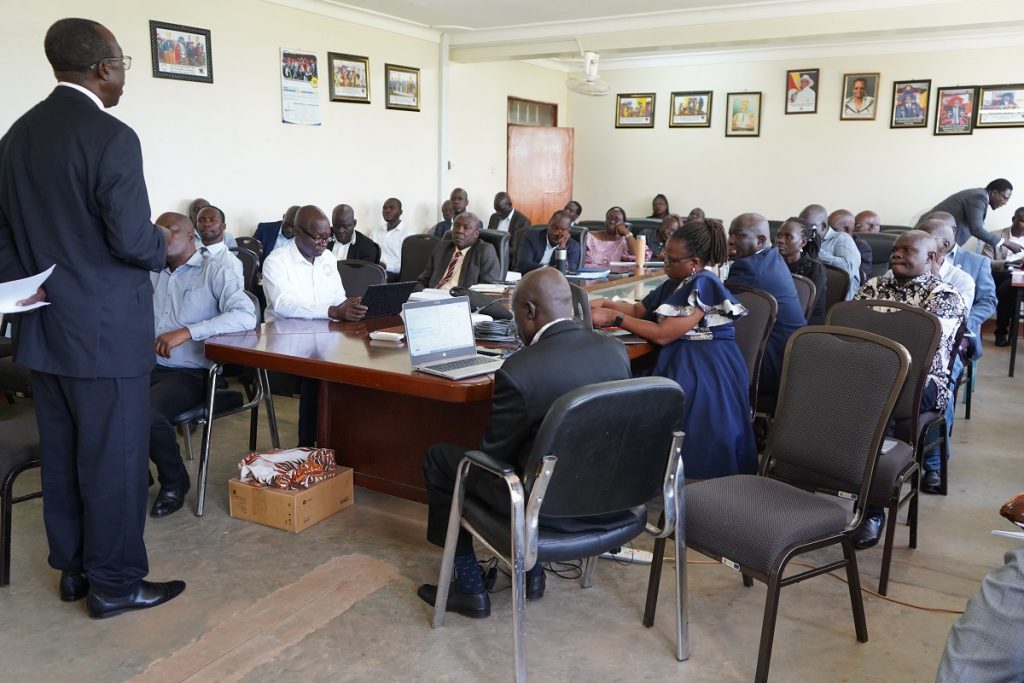
University Council members and technical staff at the Budget Conference attentively listening to Council Chair, Mr. Geoffrey David Opiokello
Mr. Atim said the objectives of the Conference were three-fold; to review the performance of the previous and current financial year plans and budgets (achievements, best practices, challenges and lessons learnt); to propose priorities that can be funded within the framework of the Council Budget for the next financial year; and to provide an opportunity for networking and collaboration with other Development partners on the University’s unfunded priorities and off-budget financing.
In the FY 2027/28, Mr. Atim said, the University shall specifically prioritize construction of the Faculty of Management Sciences, running of cutting-edge academic programmes aligned to the Competence-Based Education and Training (CBET) curricula and supply of Medical and Science Laboratory equipment.
He named other priorities as investment in ICT through increasing the bandwidth from 174 megabytes per second (mbps) to 300 mbps, student-led research, innovation and publications, human resource planning and management, staff capacity development and general welfare, strategic partnerships & collaborations, University road network, fleet and utilities; statutory and contractual obligations, proper operation and maintenance of completed facilities; and general supervision.
On the Budget performance, Ag. Bursar, CPA. Anthony Elemu said, activities not implemented or delayed in a financial year, requires improvement on work planning and quarterly monitoring.
CPA. Elemu said for revenue realised below target, there is a dire need to strengthen collection, billing and reconciliation. To avoid delayed procurement and incomplete procurements, Elemu said, “we need to align procurement plans with approved budgets and implementation schedules.”
He called for quantified workplans to aid financial planning and budgeting, timely and reliable financial statements and information to facilitate accounting and financial reporting.
On budget execution (Expenditure Management), CPA Elemu encouraged disciplined implementation of the approved budget, with strong commitment controls (spending within budget).
Faculty Deans and Directors presented their budget wishes, indicating priority areas for the next financial year. Council Members, Heads of Department and Units, among others, attended the Budget Conference.